
Aurora's Brand New Expedition Ship - Douglas Mawson
How lucky am I?
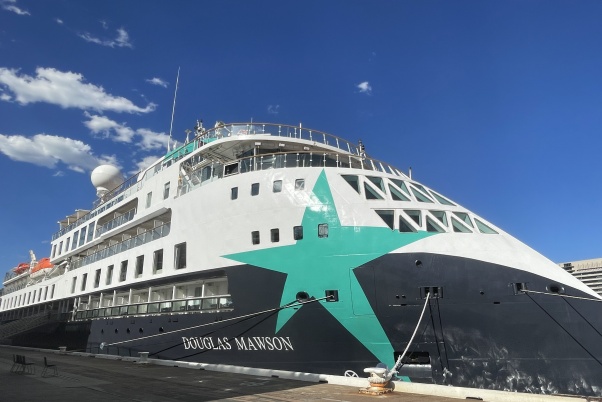
Every now and then, my job gifts me with one of those “pinch-me” moments, and this week absolutely delivered. Thanks to my affiliation with CLIA (Cruise Lines International Association) Australasia and the training I do with them, I was invited to step aboard—and learn all about—Aurora Expeditions’ brand-new (and I really do mean brand-new) X-Bow expedition ship, the Douglas Mawson.
She was in Sydney on Thursday for her christening, and because she’s an expedition ship designed for the polar regions, it’s unlikely we’ll see her back in our harbour anytime soon. So yes, I was among the very first people to walk her decks.
Travel Weekly summed it up beautifully when they wrote that Douglas Mawson, one of Australia’s most respected scientists and explorers, is honoured through this vessel, a “living tribute” that reflects Aurora Expeditions’ focus on education, conservation, and sustainable travel. In a fitting nod to her icy future, she was christened not with champagne but with Antarctic ice by Mawson’s great-granddaughter, Emma McEwin.
Sustainability from Bow to Stern
Let’s start with the feature you notice immediately: the X-Bow. Her uniquely shaped “nose” is designed to slice more smoothly through polar ice and ease the notorious swells of the Drake Passage. That shape also makes her more hydrodynamic, which means a smoother, more fuel-efficient ride. Inside, this design opens up gorgeous spaces - the Citizen Science Laboratory, a serene library, and plenty of natural light thanks to expansive windows.
Aurora’s sustainability choices also extend well beyond hull design:
Local sourcing: All food on board is purchased from suppliers near each home port - true “farm to plate” dining. Ethical menus: You won’t find caviar, roe, or salmon onboard because Aurora hasn’t found suppliers whose practices meet their sustainability standards. And let’s be fair - eating fish eggs is not a great way to ensure their future populations. Renewable fuel trials: Aurora has tested hydrotreated vegetable oil (HVO) biofuel on other ships, achieving a remarkable 90% emissions reduction. Further trials are planned. Smarter navigation: They’ve partnered with Australian company Counter Current, whose AI technology analyses thousands of navigation possibilities in moments - taking into account wind, currents, and satellite data gathered through the ships on board technology - to help the crew choose the calmest and most fuel-efficient routes. Microplastic reduction: Industrial-grade microplastic filters are installed on all washing machines to reduce fibre pollution - a significant contributor to ocean microplastics.
Citizen Science at Sea
Every Aurora sailing in the Arctic and Antarctic contributes to real scientific research. Guests are invited to join in: the ship houses a dedicated science area with telescopes, microscopes, and other equipment used alongside the onboard scientists (who also serve as expedition guides) for you to have a more immersive experience. It’s a mix of exploration, learning, and hands-on environmental monitoring.
Aurora also supports global marine conservation projects, including planting kelp, coral, and sea grass in places ranging from Canada to Costa Rica and Indonesia, plus removing an average of 1kg of ocean rubbish per guest booked with them.
Even the guest parkas you receive are PFA-free, made with recycled materials, and arrive in recycled packaging.
First Impressions of the Ship
The décor is calm and understated—navy, browns, and silvery tones. Cabins come in several configurations, including cleverly designed solo rooms (I especially appreciated the full-length mirror on the outside of the wardrobe as a subtle space saving idea). Staterooms offer plenty of USB ports—though no USB-C—and universal plug sockets for US, AU, and EU devices. Starlink Wi-Fi is included.
Many balcony category cabins have beds facing the ocean view, so you can sip a morning coffee while watching the world drift by without ever stepping outside on chilly days. The balconies themselves are generous in size - and if you look closely at my photos, you may spot something unusual about the furniture, both outdoors and around the ship.
Waiting in each cabin is a thoughtful welcome kit: a refillable water bottle and your own polar jacket with a warm fleece lining and water- and wind-resistant shell. You get to keep it, which is always a nice touch.
This is a small ship—just 154 guests at maximum, or 130 on polar itineraries. With only 100 people allowed on the ice at any given time and limited kayaks, paddleboards, and zodiacs, the smaller capacity ensures everyone gets off the ship and into the action without feeling restricted.
Life Onboard
All meals are included, with buffet breakfast and lunch and à la carte dinner in the main dining room (which fits everyone comfortably in one seating). Drinks are included with dinner but available for purchase all day. That said, expedition days start early and are full of activity, so this isn’t a “cocktails-by-the-pool-all-afternoon” kind of cruise. Safety rules also mean no participating in activities while under the influence.
There are no big production shows of an evening on this ship - the focus is on enrichment: lectures, briefings, and fascinating presentations from members of the 22-person expedition team, 11 of whom also specialise in operating your water-based activities.
Other highlights:
The nearly 270-degree observation lounge, perfect for a hot chocolate and glacier watching. A central lounge for presentations. A well-equipped medical centre also stocked with plastic stretchers designed for ice or water retrievals. An upper-deck bar with colourful lounge seating, two Jacuzzis, a swimming pool, and an additional sun deck near the bow. A lovely sauna for easing tired muscles. Guitars in the bar area for guest use if you are feeling musical.
Between polar seasons, the ship will also operate in Europe, visiting small, lesser-known ports that larger ships can’t reach.
Off-Ship Adventures
The mudroom - your staging area for excursions - is spacious and impressively organised. There are walking sticks, those special prong devices (I still don’t know their real name), to help you yank off your supplied long and heavy waterproof boots, and four separate exits to avoid bottlenecks when loading onto zodiacs.
If you want to kayak, you’ll need to demonstrate prior experience - there’s a good safety reason for this (to do with your ability to extract yourself from the kayak in polar waters if you roll over) - otherwise canoes are offered for those with less experience. On most days there are two or even three opportunities to get out on the water.
The famous Polar Plunge you can opt to participate in is supported by medical staff in a zodiac, and yes, you’re clipped via a rope to the ship at all times. Once you’re out, you can warm up from the inside with a complimentary shot of vodka!
Dress onboard is relaxed and practical. At any moment, the captain might spot wildlife or an interesting landing point and spontaneously launch an excursion. If you can get in and out of a car, the crew says you can get in and out of a zodiac.
What I Loved—and What I Didn’t
The facilities, equipment, décor, and food all stood out. I loved the size of the ship, the low guest numbers, and Aurora’s B Corp certification, which reinforces their commitment to conservation and sustainability. The open bridge was a highlight too (and if it’s not open when you are sailing, just ask). Most of all, I loved the natural light flooding the public spaces - especially in the observation lounge, library, and the stunning staircase connecting these decks up in the unique X-Bow area of the ship.
Downsides? Only small ones and certainly not deal breakers. The stairs between decks felt a little steeper and narrower than expected—though that might just be me and my knees! The rise of each step felt quite high with each one you climbed. But guess what – not an issue as there are lifts to all levels of the ship, except the very top sundeck. And the presentation lounge has several columns in the room, which slightly interrupt the sightlines. With multiple screens, it’s not a real problem, and I assume it’s a structural necessity—strength and safety over aesthetics.
Where to Next?
The Douglas Mawson is currently on her maiden voyage around Tasmania, but soon she’ll be heading out across the globe.
For the icy landscapes:
10-day expeditions from Ushuaia like Antarctic Explorer: A Culinary Quest, Antarctic Explorer in Partnership with New Scientist Discovery Tours, or Antarctic Peninsula: Fly the Drake. Longer itineraries like the 20-day In Shackleton’s Footsteps.
For something warmer:
An 11-day Venice to Dubrovnik: Eight Million and One Dalmatians in July next year. A D Day Commemoration voyage from London. Greece & Turkey: Turkish Delight departing Athens in August 2026.
And many more.
More about Aurora Expeditions is available through their website, or to enquire on a specific departure, please reach out to me.
You can either email or give me a call. 0404 831 867 | sfenton@mtatravel.com.au
To both CLIA and Aurora, I’m genuinely grateful for the chance to explore this new ship, learn about the guest experience and behind-the-scenes operations, and see firsthand the heart and thought behind expedition cruising. Wishing the Douglas Mawson smooth sailings ahead.